Tuesday, May 31, 2011

Detailed Manufacturing Rules

 Redi-mix Trucks

Every state has different rules for manufacturing.  And I covered the major rules here.  Today, I thought I'd review some of the more detailed taxing policies that you may deal with.

Where does the manufacturing process begin and where does it end?  The first requirement to worry about, for most manufacturing exemptions, is that the item must be used in the manufacturing process.  Usually, it starts at the first machine and ends at the last machine.  The last machine is often packaging the product for the final consumer - putting beer in the can, for example.  Sometimes the manufacturing process includes the transportation of raw materials to the first machine and transportation of the finished goods to the warehouse.  And in a few situations, the process even includes the raw material and finished goods inventory as well as the shipping department.  Not often, though.

Materials handling equipment, like lift trucks, pipes and conveyor systems, if used directly within the manufacturing process, will usually be exempt.  But beware.  There are a couple of states that specifically exclude this type of equipment from the manufacturing exemption.  Also, some states require that the equipment be used exclusively in the process.  The rest usually require that the equipment be used predominantly in the process.  This is a challenge when you're running lift trucks all over the plant.

Concrete mixers are, in many states, considered manufacturing equipment.  This is because, after the materials are loaded into the truck, there is still some processing being done in the drum as it's heading to the job site.  Hence, it could be considered manufacturing equipment.  But note that, in states where this exemption exists, it doesn't extend to the truck itself.  The exemption only applies to the mixer.

Cleaning of manufacturing equipment is usually not considered directly used in manufacturing.  However, if the cleaning is necessary for a food processor, then it's sometimes exempt.

Speaking of clean, clean rooms are sometimes exempt as well.

Sometimes, big manufacturing machines will require specialized concrete foundations.  These may be exempt in some states, even though they are permanent (and really heavy) additions to real property.

Power generation equipment is frequently exempt if the power is being used by manufacturing equipment.  Less often, transformers for electricity coming from mains is exempt.

Employee safety items, such as gloves, goggles, helmets, aprons, etc. are surprisingly not generally exempt, even if they are required by OSHA.  One problem is that they are rarely directly used in the manufacturing process. 

There are even more detailed manufacturing rules, but this should do for now.  And I just realized that there were no jokes in this article.  Sorry.  Maybe next time.


The Sales Tax Guy
http://salestaxguy.blogspot.com

See the disclaimer - this is for education only.  Research these issues thoroughly before making decisions.  Remember: there are details we haven't discussed, and every state is different.  Here's more information

Get these articles in your inbox - subscribe at http://salestaxguy.blogspot.com

Don't forget our upcoming seminars and webinars.
http://www.salestax-usetax.com/
Picture note: the image above is hosted on Flickr. If you'd like to see more, click on the photo. 

Tuesday, May 17, 2011

Golden Rule: Three Different Types of Property

Detail of Jackson Building - 1924

[This is an overhaul of an article originally written in February of 2009]

While there are variations for what constitutes real and tangible personal property, these are pretty good definitions in most states.

Real Property

Real property is generally property that has been:

1. permanently
2. affixed to other real property (like land and buildings) and
3. is integrated into the value or use of that real property.

Permanent usually means there are no plans or expectations to remove the item - it will last as long as the building or at least 10 to 20 years.

Affixed means that you'd cause significant damage if you removed the addition.  

"Integrated" means that the additional property extends the life or increases the value of the existing real property. In addition, it would be something that would be expected in the building or that facilitates the purpose of the building (like a roof).

One test that I've seen is: if the building were purchased, would the new owner retain the addition, or would they probably tear it out?  In other words, is the addition something that is fundamental to the purpose and value of the building?  For example, if someone buys a house, would they keep the old draperies?  Probably not.  They might keep the Venetian blinds, but the drapes?  Blech.  Out they go!

Effect on construction contractors

If a construction contractor permanently affixes TPP to real property, and it becomes integrated into that real property, she has converted that TPP into real property.  In most states, the contractor's sale wouldn't be taxable and she would pay tax on the TPP when purchased by her.

TPP - Tangible Personal Property

Tangible personal property is property that is perceptible to the human senses (tangible), and is not real property. See above.

A simpler way to describe at TPP that is not as accurate, but easier to grasp, is: tangible personal property can be moved without causing damage to the property or to any property it is attached to.


Note that sales of real property are not generally taxable, but that sales of tangible personal property are, by default,taxable.  There are lots of exceptions and variations.

Intangible Personal Property

And then there's a third type of property: intangible personal property.


The Sales Tax Guy
http://salestaxguy.blogspot.com

See the disclaimer - this is for education only. Research these issues thoroughly before making decisions. Remember: there are details we haven't discussed, and every state is different. Here's more information

Get these articles in your inbox - subscribe at http://salestaxguy.blogspot.com

Don't forget our upcoming seminars and webinars.
http://www.salestax-usetax.com/

Picture note: the image above is hosted on Flickr. If you'd like to see more, click on the photo.

Friday, April 22, 2011

Things Change

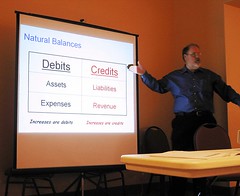
"So let's talk debits and credits"I was doing an on-site seminar earlier this week, and one of the things that came up, that I thought would be worth mentioning here, is that things change.  The problem is that we make decisions about sales and use taxes (along with everything else) and then move on.  A few years pass and things have changed.  But those decisions are still in place.  And if someone asks about it, you say, "Oh, we decided about that years ago."

Have you reevaluated the situation to see if the sales tax situation has changed?

Here are just a few things that immediately spring to mind where you might make a decision, and see the situation change, resulting in a serious error down the road.

Nexus
A couple of years ago, you decided the the presence you had in a state did not mean you had nexus.  You were even right!  But then, over the years, you have more sales people visit the state, you start renting equipment in the state, do some seminars, send your own trucks into the state, or some court cases are decided which result in you now having nexus.

And then, there are the new states you're in that you haven't even considered.  

Taxable services
You've determined that the services you offer aren't taxable in the states where you sell.  But are you subscribing to a tax newsletter to make sure that the state doesn't make those services taxable?  States are constantly looking for ways to expand their tax base and adding taxable services is one of the ways.  If you're not staying up to date, you're in for a surprise.

Occasional sales of equipment
In the past, you've occasionally sold the odd piece of equipment.  Those were occasional sales in most states.  But your business has grown and now you're an equipment dealer.  I just wrote an article about this last week. 

The moral?  Periodically you should take a big picture look at your past sales tax decisions and see if anything needs updating. Don't assume that the decision you made a couple of years ago is still good.


The Sales Tax Guy
http://salestaxguy.blogspot.com

See the disclaimer - this is for education only.  Research these issues thoroughly before making decisions.  Remember: there are details we haven't discussed, and every state is different.  Here's more information

Get these articles in your inbox - subscribe at http://salestaxguy.blogspot.com

Don't forget our upcoming seminars and webinars.
http://www.salestax-usetax.com/
Picture note: the image above is hosted on Flickr. If you'd like to see more, click on the photo. 

Friday, April 15, 2011

Want to keep up on the Amazon news?

Spanish Moss on Pintail Lake Trail C

Our good friends at Amazon.com are making a LOT of sales tax news lately.  Whenever I look at the news, most of the articles seem to be about Amazon.  There are "associate" laws being passed in various states, including Illinois I'm embarrassed to say.  Then you've got politicians, editors and business people complaining about the unfair advantage Amazon has.  I don't necessarily disagree with their sentiments.  It's just that their lack of grasp of the underlying laws is really annoying.  And I'll bet very few of those politicians, editors and business people pay the use tax on their Amazon.com purchases anyway.  Sigh.

Rarely is there a reasoned and intelligent article, and when I come across those, I try to tweet them.  But I'm going to avoid the rest of it.

So if you're game to keep track of Amazon's sales tax adventures, here's a link for you.


The Sales Tax Guy
http://salestaxguy.blogspot.com

See the disclaimer - this is for education only.  Research these issues thoroughly before making decisions.  Remember: there are details we haven't discussed, and every state is different.  Here's more information

Get these articles in your inbox - subscribe at http://salestaxguy.blogspot.com

Don't forget our upcoming seminars and webinars.
http://www.salestax-usetax.com/
Picture note: the image above (jungle - Amazon - get it?) is hosted on Flickr. If you'd like to see more, click on the photo. 

Monday, April 11, 2011

Parables and Illustrations: Do you sell equipment?

Big Yellow Truck

If you sell old equipment, you may be making taxable sales.  Have you taken a look at this problem?

One particular construction company that I'm familiar with (heavy/highway) is constantly buying new equipment.  Constantly.  The owner really likes new equipment (he must have been a big fan of Tonka toys as a child). 

In the old days, as he bought new equipment, the owner would need to sell the odd piece of used equipment.  This happened a couple of times a year and the transactions were concluded over a beer at the local tavern.  These were "occasional sales" and wouldn't be taxable. 

But, as the years went by, and the company grew, they found themselves getting rid of more and more used equipment.  They added "selling equipment" to the job description of one of the purchasing guys and started paying him a commission.  They parked the equipment in front of the building, put a sign up, and installed lights so that the equipment could be seen at night.  The deals were now closed at the office, not over a beer.  The company had become a used equipment dealer.  But they did not realize that.  Until the audit.

The state came in and noticed the amount of cash being thrown off by the equipment sales.  They also noticed the lights, signs, etc.  The auditor said, "you know, you should be charging tax on all of those sales."  The company talked to a lawyer, who referred them to a sales and use tax lawyer, who told them they were screwed.  The assessment was over $300,000 with the interest and penalties.  The lawyer helped get that reduced, but it still hurt.

Another situation was similar, but not as painful. 

A hospital found themselves selling lots of used medical equipment.  They could afford to be spendthrift because of the patient mix in their service area (lots of private insurance).  They sold the used equipment to other, poorer hospitals, clinics, and physicians offices.

Yes, the hospital was a non-profit organization.  But sales by non-profits are usually taxable, other than fund-raising events.  So this hospital should have been charging tax.

"But wait! Weren't they selling the equipment to other exempt hospitals?  So the sales would still be exempt, right?"

Yep.  But remember that not all hospitals are government or non-profit operations.  There are for-profit hospitals too.  And they sold equipment to physicians and clinics who are generally taxable.

Luckily, unlike the construction company, this organization realized what they were doing and began collecting taxes before they got caught.

Not such a horror story, but illustrative anyway.


There are three major points to be made here:

1.  You may be selling so much equipment that you become an equipment dealer.  If you're doing more than selling the odd item over a beer, you should take a hard look at the situation.

2.  Your core business may not be your only source of taxable sales.  Other sales may be taxable without you realizing it.  Until the audit.

2.  Your company changes.  If you make a judgment about the taxability of something today, will the same set of circumstances and laws exist in five or ten years?  You need to frequently re-analyze what you are doing.  Don't just rely on the decision that was made in the good old days.


The Sales Tax Guy
http://salestaxguy.blogspot.com

See the disclaimer - this is for education only.  Research these issues thoroughly before making decisions.  Remember: there are details we haven't discussed, and every state is different.  Here's more information

Get these articles in your inbox - subscribe at http://salestaxguy.blogspot.com

Don't forget our upcoming seminars and webinars.
http://www.salestax-usetax.com/
Picture note: the image above is hosted on Flickr. If you'd like to see more, click on the photo. 
Friday, March 04, 2011

Illustrations and Parables: A weird invoice where they paid extra California taxes for a shipment of non-taxable items to Idaho

Burned Stump
The following is a true story.  I've randomly changed the names, states and products so that nobody, least of all me, will get in trouble.  But it had to be told.

I received a call from one of my previous class participants on Wednesday.  Doris had emailed me a question the day before, but it was so long and involved that I wanted to talk about it on the phone.  I had a long drive in Chicago morning traffic, so she called me back at the perfect time. 

Doris had sold some boxes to Sam in Idaho.  The boxes were containers for Sam's product so they were bought for resale and Doris had Sam's resale certificate.  Doris had billed Sam, with no sales tax on the invoice, since it wasn't taxable. 

But then Doris got a call from the Sam's distributor in California.  For some reason, they were going to pay the bill.  Here's the conversation:

Distributor: I have your invoice here for the boxes you sold to Sam.  Why didn't you charge sales tax?
 
Doris: It's not taxable.  They're boxes for his products so they qualify as exempt.

Distributor: No they're taxable.  You need to rebill us with California sales tax.

Doris:  You're wrong.  They're not taxable.  It's called the "container exemption."  I'd be happy to send you more information.

Distributor:  I need to have California tax on this invoice.

Doris:  But I can't bill you California tax anyway.  We aren't registered in California, don't do business in California and don't have nexus there.  I can't collect taxes for a state I'm not registered in.  Besides, the delivery occurred in Idaho, therefore it would be Idaho tax anyway.  But it's not taxable!

Distributor:  If you don't charge me California tax, we'll just add the tax to the payment.

Doris: If you do that, I'll just have to send you a refund check.  We can't accept that money.

Distributor:  We won't cash it.

At this point, Doris, realizing she was talking to a tree stump, gave up and sent me the email. 

After we went through the whole thing, Doris asked, "I'm right, aren't I?"  I said, "Absolutely!  The best chance you have is that the person who handles the refund check won't have heard from this idiot.  They'll deposit it and that'll be it.  Out of curiosity, what part of accounting was the person from?"

Doris replied, "She was the sales rep."

"Ah.  Now it makes sense."

If there's anyone who'll stick to their guns, on a topic they know nothing about, in the face of someone who clearly knows what they're talking about, it's a sales rep.  (I kid, I kid.  I spent years in sales)

I explained to Doris that she needed to keep very detailed notes on this situation because of two potential scenarios:  

1.  The California distributor gets audited by the state of California who discovers that taxes were paid to Doris.  The auditor will ask Doris what she did with the money, since she's not registered in California.  Doris will need to be able to document that she did refund the money.

or

2.  The California distributor hires a reverse sales tax auditor who comes across this weird invoice where they paid extra California taxes for a shipment of non-taxable items to Idaho. [Boy, as soon as I wrote that, I knew I had the title of this article.]

The auditor will immediately call Doris and demand a refund for the overpayment.  Again, Doris will need to be able to document the refund.


Now the other thing that the sales rep didn't know about (and many of you probably don't know either) is that refusing to cash the check doesn't really solve the problem.  After about a year or so, depending on the state, it will become an unclaimed property issue.  Doris will have to send a letter to the company telling them they have an uncashed check.  If they still refuse to cash it, Doris will then turned the money over to the abandoned property department of the state.  Her job will then be finished.  The money has been paid, in this case, to the state.

Now, when that reverse sales tax auditor calls about the overpayment, Doris can just say, "Yeah, that company you're working for refused the payment.  We had to turn it over to the state treasurer.  Call them.  Not my problem anymore."

But, as I said, Doris needs to document the heck out of this.  Because she'll be lucky if this doesn't pop up again in the next three or four years.

And here's a message for sales people, or any non-accounting folks out there.  If the accounting people seem to know what they're talking about, there's a chance they do.  I'm just sayin'.


The Sales Tax Guy
http://salestaxguy.blogspot.com

See the disclaimer - this is for education only.  Research these issues thoroughly before making decisions.  Remember: there are details we haven't discussed, and every state is different.  Here's more information

Get these articles in your inbox - subscribe at http://salestaxguy.blogspot.com

Don't forget our upcoming seminars and webinars.
http://www.salestax-usetax.com/
Picture note: the image above is hosted on Flickr. If you'd like to see more, click on the photo. 

Friday, February 25, 2011

An Interesting Issue with Rental of Tangible Personal Property

Skyjack

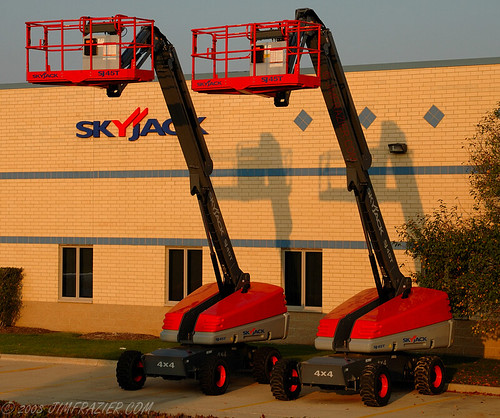
I came across an interesting item when I was browsing New Jersey's sales and use tax rules today. It's regarding the leasing and rental of tangible personal property.

First of all, to recap the general rule in most states: the rental of tangible personal property is a taxable sale. The lessor must charge sales tax on the rental charge of the TPP. But this also allows the lessor to buy the equipment "for resale" so he doesn't have to pay sales tax on his purchase. All he has to do is provide a resale certificate to his vendor. Done.

Now this particular glitch is one I noticed because it was clearly spelled out for New Jersey. But it probably applies in the other states as well.

The lessor buys equipment to rent. He pays no sales tax. He charges his customer tax. But what happens when there's an operator involved?

Now we have to figure out if the real transaction is the hiring of the operator, with the equipment becoming incidental to the real purchase of the operator's services.  Or are we still renting a machine and the operator is just there because we don't know what levers to pull? 

There are a couple of different ways that the states handle this:

1.  If the operator has control over how the machine is used, it's no longer a taxable rental (with some variations on what is meant by control).
2.  If the cost of the operator is more than the cost of the rental, it's no longer a taxable rental.
3.  If there's an operator, it's no longer a taxable rental.  Period. 

Here's the glitch:  Let's say you routinely provide your equipment with an operator.  And based on the way the state's law works, the rental becomes non-taxable.  Then you really can't be purchasing the equipment with a resale certificate anymore, because you're really not buying for resale.  You're not charging sales tax anymore because you're not making taxable sales.  You're really using your equipment, or rather, your operator is.

So, if you're the lessor, you should have had your vendors charge you tax (or you should have paid use tax) when you bought the equipment you rent with an operator. Which means, if this is new to you, you owe the state a bucketload of money. 

Interesting huh?  I wonder how many leasing companies do this;  Or have gotten busted on this.  And I wonder how many auditors even check for this.  

This illustrates a larger issue.  Many sales tax exemptions are based on how you will use the purchase (or not use it, in the case of the resale exemption).  But if you change your mind later, you lose that exemption.  How many of you are paying attention to this?  Here's another example where sellers get burned all of the time.

Hope I didn't ruin any weekends.

Well, OK, yeah, I kinda do.  (grin)


The Sales Tax Guy
http://salestaxguy.blogspot.com

See the disclaimer - this is for education only.  Research these issues thoroughly before making decisions.  Remember: there are details we haven't discussed, and every state is different.  Here's more information

Get these articles in your inbox - subscribe at http://salestaxguy.blogspot.com

Don't forget our upcoming seminars and webinars.
http://www.salestax-usetax.com/
Picture note: the image above is hosted on Flickr. If you'd like to see more, click on the photo.