Showing posts with label Golden Rules. Show all posts

Friday, June 27, 2014

Golden Rule of Sales and Use Taxes: The Seven Factors that Determine the Taxability of Any Sale

Warning

What state has jurisdiction?


Generally, with few exceptions, the place where the buyer, or the buyer's agent, takes physical possession or control of the goods is the state that has jurisdiction.  When it comes to services, it's a little messier.  It's usually where the services were performed but sometimes it's where the buyer receives the benefit of the services.

This the first question you have to answer.  All of the other answers depend on the delivery state.

If you're the seller, a corollary factor is whether you have nexus in the state.  If you don't, then you probably don't have to worry about the rest this article.  Yay!

Who is the buyer, or the seller?


In most states, there are exemptions for sales to non-profits and government agencies.  And there are usually more limited exemptions for sales by these types of organizations.  In addition, there are often very specific exemptions for certain organizations who have managed to gain special deals based on how wonderful the politicians think they are.

By the way, you'll usually need exemption certificates for this factor.

How will the purchase be used?


There are exemptions for organizations using the purchase for manufacturing, agriculture, research and development, etc.  Or the buyer may not use it at all, which means it's being bought for resale.  

By the way, you'll usually need exemption certificates for this factor as well.

Where will the purchase be used?


Many states establish geographic areas within the state (I generically call them enterprise zones) where there are loads of exemptions.  In addition, there are variations within a state, based on local jurisdiction rules.  I don't even want to go there.  I'm looking at you, Colorado.

When will the purchase be used


Many states have sales tax holidays for things like clothing, school supplies, guns, energy saving appliances and hurricane supplies.  These holidays are usually only for a limited amount of time - a weekend in most cases.  Then you also have to keep in mind that politicians change their minds.  Or want to limit the amount of the damage they do.  So there are always effective dates when new laws go into effect.  And there are often sunset dates on laws, particularly exemptions.

What is the type of the sale?


Is it a rental or long term lease?  Is it a simple sale or installment sale?  Is it a gift?  Or perhaps it's an occasional sale?  And if it's an occasional sale, is it a business that's selling or buying?

What is being sold?


Finally, there are exemptions for things based solely on what the purchase is.  Is it food or drugs?  In a few states, clothing is exempt.  Maybe it's an intangible.  And of course, just about any service you can name is taxable somewhere.


The Sales Tax Guy http://salestaxguy.blogspot.com

See the disclaimer on the right.

Don't forget our upcoming seminars and webinars. http://www.salestax-usetax.com and there's more sales tax news and links here http://salestaxnews.blogspot.com

Picture note: the image above is hosted on Flickr. If you'd like to see more, click on the photo.

Tuesday, May 17, 2011

Golden Rule: Three Different Types of Property

Detail of Jackson Building - 1924

[This is an overhaul of an article originally written in February of 2009]

While there are variations for what constitutes real and tangible personal property, these are pretty good definitions in most states.

Real Property

Real property is generally property that has been:

1. permanently
2. affixed to other real property (like land and buildings) and
3. is integrated into the value or use of that real property.

Permanent usually means there are no plans or expectations to remove the item - it will last as long as the building or at least 10 to 20 years.

Affixed means that you'd cause significant damage if you removed the addition.  

"Integrated" means that the additional property extends the life or increases the value of the existing real property. In addition, it would be something that would be expected in the building or that facilitates the purpose of the building (like a roof).

One test that I've seen is: if the building were purchased, would the new owner retain the addition, or would they probably tear it out?  In other words, is the addition something that is fundamental to the purpose and value of the building?  For example, if someone buys a house, would they keep the old draperies?  Probably not.  They might keep the Venetian blinds, but the drapes?  Blech.  Out they go!

Effect on construction contractors

If a construction contractor permanently affixes TPP to real property, and it becomes integrated into that real property, she has converted that TPP into real property.  In most states, the contractor's sale wouldn't be taxable and she would pay tax on the TPP when purchased by her.

TPP - Tangible Personal Property

Tangible personal property is property that is perceptible to the human senses (tangible), and is not real property. See above.

A simpler way to describe at TPP that is not as accurate, but easier to grasp, is: tangible personal property can be moved without causing damage to the property or to any property it is attached to.


Note that sales of real property are not generally taxable, but that sales of tangible personal property are, by default,taxable.  There are lots of exceptions and variations.

Intangible Personal Property

And then there's a third type of property: intangible personal property.


The Sales Tax Guy
http://salestaxguy.blogspot.com

See the disclaimer - this is for education only. Research these issues thoroughly before making decisions. Remember: there are details we haven't discussed, and every state is different. Here's more information

Get these articles in your inbox - subscribe at http://salestaxguy.blogspot.com

Don't forget our upcoming seminars and webinars.
http://www.salestax-usetax.com/

Picture note: the image above is hosted on Flickr. If you'd like to see more, click on the photo.

Friday, June 18, 2010

Golden Rule: The Resale Exemption

You can have anything you want, as long as you want cheap, plastic crap.This one is so obvious, it's taken me until now to make it a golden rule.

The idea of sales tax is that it's a tax on consumption. In other words, it's a tax on the transaction that involves the final consumer (end user). Most transaction oriented taxes are set up that way.

It's a different story when you start talking about who the tax is imposed on. Some states have a "gross receipts" tax, for example. The tax is legally imposed on the seller, but they are generally allowed to pass it along to the end user. But that "gross receipts" tax is still only imposed on the gross receipts of sales to the end user.

Who is the end user?

It's really hard to positively define them. So we use a negative definition - who isn't the end user? As discussed in the golden rule of taxable sales, "the final consumer is generally going to be the person who bought for any other reason than to resell..."

If you bought something to consume, you're the end user.
If you bought it to save or collect, you're the end user.
If you bought something to give to someone else, you're still the end user.

But if you bought it to resell to someone else, then you're not the end user. You're buying it for resale. The sale to you is exempt in virtually all states. Now before you start telling the good people at Wal-Mart that you're buying for "resale," a word of caution. You still have to go through all the state's registration paperwork, provide the seller with a resale certificate, and you'll have to file sales tax returns. Other than that, simple.

Why do consumption taxes only involve consumer transactions?

Because if the tax was imposed every time there was a sale, then the taxes would pyramid. For example:

The iron mine charges sales tax to the steel mill
The steel mill charges sales tax to the fabricator
The fabricator charges sales tax to parts wholesaler
The parts wholesaler charges sales tax to the component manufacturer
The component manufacturer charges sales tax to the car manufacturer
The car manufacturer charges sales tax to the car dealer
The car dealer charges you sales tax

You wind up paying a whole lot more for that car because everybody added that 8% sales tax into their costs and prices. That's pyramiding. So consumption taxes are only imposed on that last transaction.

The resale exemption justifies other exemptions, to some extent:

Containers
Agriculture
Manufacturing
Direct supplies used by taxable service providers (in some states)

What about use tax?

Remember, that use tax is essentially a loophole plugger and wasn't meant to be a stand alone tax. Even though it technically isn't a tax on the transaction, it still is considered a consumption tax. It is, after all, a tax on use.


The Sales Tax Guy
http://salestaxguy.blogspot.com

See the disclaimer - this is for education only. Research these issues thoroughly before making decisions. Remember: there are details we haven't discussed, and every state is different.

Get these articles in your inbox - subscribe at http://salestaxguy.blogspot.com

Here's information on our upcoming seminars and webinars.
http://www.salestax-usetax.com/

Picture note: the image above is hosted on Flickr. If you'd like to see more, click on the photo.

Thursday, June 03, 2010

Golden Rule: There is no sales tax on interstate transactions

Yeah, I said it. And I'll say it again. There is no sales tax on interstate transactions.

Note that I said interstate transactions, where the item is shipped from one state to another state.

Sales tax does apply to intrastate transactions, where the item is simply shipped from one point in the state to another point in the same state.

Since sales tax doesn't apply to interstate transactions, what tax does apply? You got it...use tax. Since use tax is a tax on the use of an item, as opposed to the transaction (like sales tax), use tax can plug the loophole where the sales tax couldn't be collected, namely interstate transactions. Heck, that's what it was invented to do!

So, when it's an interstate transaction, there's no sales tax. But there is use tax. The buyer has the responsibility of paying the use tax to the state. However, if the seller has nexus in the state, the the seller has to collect the use tax from the buyer. It'll look a lot like sales tax since the rules and rates are generally the same.

To see an illustration of why this is the case, please see this three part series. It's got pictures, maps and everything!


The Sales Tax Guy
http://salestaxguy.blogspot.com

See the disclaimer - this is for education only. Research these issues thoroughly before making decisions. Remember: there are details we haven't discussed, and every state is different.

Here's information on our upcoming seminars and webinars.
http://www.salestax-usetax.com/

Picture note: the image above is hosted on Flickr. If you'd like to see more, click on the photo.

Tuesday, March 09, 2010

Sales tax and use tax are complementary

Use tax, as mentioned elsewhere, is a loophole plugger. It was invented for the situations where sales tax couldn't be imposed.

In more high-highfalutin language, we say that use tax is a complementary or compensating tax. In addition to plugging those loopholes, it also means that the rules are generally the same. In every state, the state sales tax rate and the use tax rate are the same. In every state there are very few significant variations between the taxing policies for sales tax and use tax. That's because use tax wasn't intended to do anything other than collect the taxes that the state couldn't collect through sales tax.

But there are two major variations:

1. In some states, the total sales tax rate and use tax rate may vary. That's because, in those states, the local component of the rate is only sales tax, not use tax. For example, in my town in Illinois, the total rate is 8%, which is made up of 6.25% for the state and 1.75% for the city. But that 1.75% is only sales tax, not use tax. So when I order something from Amazon.com, who won't be charging me tax, and fill out the Illinois use tax return, I only have to pay 6.25% use tax. The city won't get any of that money.

Illinois does it that way. But even in Illinois, there is weirdness. For most places and states, use tax does apply to the local component. But there are enough twists and turns so that you need to be aware of this complication. Now that you know, keep an eye out for it when you're inspecting local tax rules and rates.

2. The sales tax laws regarding occasional / casual sales vary when it comes to buying a car or other registerable items (ATV, boat, plane, etc. ) Even though the occasional sale of a car won't be taxable as far as the seller collecting sales tax, the buyer will have to pay use tax when they register it. That's a difference between the sales tax rules and the use tax rules.


The Sales Tax Guy
http://salestaxguy.blogspot.com

See the disclaimer - this is for education only. Research these issues thoroughly before making decisions.

Here's information on our upcoming seminars and webinars.
http://www.salestax-usetax.com/

Wednesday, September 02, 2009

Golden Rule: The Four Exceptions

There are four major exceptions to the Golden Rule of Taxability which basically says that all sales and use of TPP are taxable and all sales of services are not taxable.
  1. Just about every state will tax some mix of services, with rental of TPP, utilities, lodging, and food service being the most common.
  2. The purchases of several types of organizations, including government agencies and non-profit organizations are usually exempt. Sales by these organizations are often exempt to some extent, often if it's related to fund-raising activities.
  3. Purchases may be exempt based on how the purchase will be used. Typical exemptions are purchases by farmers for agricultural use, and by manufacturers for use in the manufacturing process.
  4. Then there are exemptions based simply on what the item is, such as grocery store type food and prescription drugs.
A good starting point for your research into all of these exceptions is our taxing policies article. Remember though, it is work in process. Another article that may help your understanding is about decision factors.

By the way, a short plug: these four exceptions are essentially the basis for our Taxing Policies by State webinar. Please join us for states you're interested in.

Sales Tax Guy

See disclaimer

Here's information on our upcoming seminars and webinars

And please don't forget to visit our advertisers!

Monday, August 31, 2009

Golden Rule: Use

Half of what this blog is about is called "use tax." What do we mean by "use?"

The meaning varies from state to state. This is most inclusive one that I've found. So it may be overkill depending on the state involved. Remember, there's an exception to everything!

"Use," in a use tax sense, means that the item is under the control of the "user."

The obvious example is the laptop on which I'm writing this masterpiece. I'm using the computer, therefore, I'd owe use tax (assuming I haven't already paid the tax).

The best example is when I store something on a shelf in my office, without even opening the box. I've used it as far as the state is concerned. I controlled it, even if I didn't get any value out of it. Therefore, I'd owe use tax (assuming I haven't already paid the tax).

Let's say that I buy a GPS unit from Amazon.com to give to my old buddy George, who works with me. I happen to be out of the office on the day the package arrives. I know George is going on vacation, and that he could really use the GPS unit (he gets lost a lot). So I call him and tell him that the package is on my desk and to please take it (I ordered it gift wrapped - I'm such a nice guy). Amazon didn't charge me tax because they don't have nexus in my state. So the responsibility falls to me to pay the use tax. While I never even touched the box, let alone the GPS unit itself, I had control over it. And, in addition, I used it by giving it to George.

Note that you don't have to own it to owe use tax. If you rent some tangible personal property and the vendor didn't charge you tax, then (depending on the state), you'll owe use tax on it. You don't own it, but you have control over it.

There are situations where contractors, who use building materials to construct a building, will have to pay use tax on the materials, even if they were purchased tax-free by the tax-exempt organization. That's because, while the organization may be exempt, the contractor isn't. And he used those materials.

This doesn't have to be hands on either. It can be by remote control.

Bottom line? You use by having control. That's all it takes.


Sales Tax Guy

See disclaimer

Here's information on our upcoming seminars and webinars

And please don't forget to visit our advertisers!

Wednesday, July 08, 2009

Golden Rule: The Basis of Tax

This is one of a series on how to handle items that affect the "basis" of tax.

Once we have determined that a sale is taxable, there remains another problem. We are going to add sales or use tax of, say, 7%. But 7 % of WHAT?

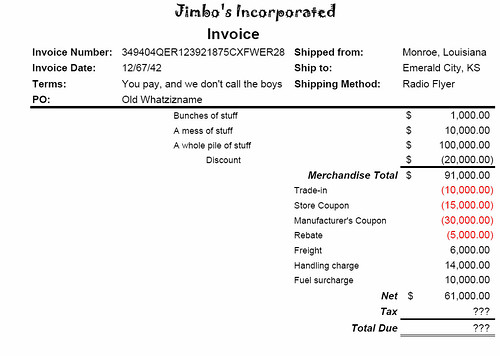
Image1

The invoice above is taxable because stuff is always taxable (that joke sounds better when I do it in the seminar - trust me). So obviously the 7% is going to be applied to the merchandise total of $91,000. But what are we going to do with those extra things, like coupons, rebates, freight charges, etc.

The rule is generally known as basis of tax - what we are going to take 7% of. Basis of tax deals with the extra items on an invoice, that is already taxable, and whether those items will be added to the basis or subtracted from the basis. So here's the actual golden rule:

All of the charges on a taxable invoice will be added to the tax basis and are therefore taxable. But all of the deductions from a taxable invoice will NOT reduce the tax basis...they have no effect on the tax.

This sounds unfair. But when you start taking apart these rules in each state, you'll find there are LOTS of exceptions. But it's helpful to start with the assumption that any charges will be added to the taxes. But deductions do not reduce the taxes.

Also, remember - this rule is only relevant if the sale is taxable. If the sale (or purchase) wasn't taxable, then forget about it. Move along, nothing to see here. We don't care about those extra items...there is no basis of tax if there isn't a tax in the first place..

For example: If I'm charging a customer freight for a shipment of no-charge parts that are covered by a warranty, then the sale isn't taxable. And the freight charge won't be taxable either. If there is no taxable sale, there's no tax. And there won't be any basis. So you're finished.

That's the theory, anyway. I have seen some weird spins on these rules, so it's important to check the applicable state's rules to make sure you're not missing anything. For example, some states will say that installation charges are taxable, regardless of the taxability of the sale of the stuff being installed. Go figure.

Sales Tax Guy

See disclaimer

We have more articles on the basis of tax.

Here's information on our upcoming seminars and webinars

And please don't forget to visit our advertisers!

Picture note: the illustration above is hosted on Flickr. If you'd like to see a larger version, click on the picture or the Flick link, then click on the "all sizes" button above the picture.
.

Friday, March 20, 2009

Wednesday, March 18, 2009

Golden Rule: Sales Tax is a Tax on the Transaction

This is a very important thing to remember as you begin to understand the theory of sales and use taxes, particularly with regard to interstate commerce. Sales tax is a tax on the sale itself. Hence its name. It is a tax on the transaction.

There will be situations where the sale can't be taxed for one or more reasons. Because of this problem, the states had to invent another tax. Yes, you've got it. Use tax. Use tax is the plug when a loophole in the sales tax law allows a transaction to go untaxed.

We'll discuss the loopholes in the future.

Sales Tax Guy

Here's information on our upcoming seminars and webinars

Monday, March 02, 2009

Golden Rule: The Ship-From State is Irrelevant

As a corollary to the delivery point golden rule, the state that TPP is shipped from has no standing. They are irrelevant.

Because:

1. They can't impose sales tax on an interstate transaction because of the Commerce Clause.
2. The only tax that will be imposed will be a tax on the buyer's use of the TPP. And that use will only occur where the buyer actually uses it, in other words: controls it. And that will not be happening if the seller actually ships it to the buyer.
3. Just about every state has a law that essentially says that there is no tax imposed if the property is shipped out of the state pursuant to the terms of the agreement. Which kind of states 1 and 2 sideways.

In a nutshell, the ship-from state is irrelevant. The delivery state gets to make the rules and impose the use tax.

But the ship-from state is going to want proof you DID ship it out of state; as opposed to the buyer coming into the state and picking the product up at your dock. So you'll need shipping documents and bills of lading that show you did, in fact, ship the goods.

Sales Tax Guy

Don't forget our coming events!

Friday, November 14, 2008

Golden Rule: Use Tax is Imposed Even if You've Already Paid Sales/Use Tax


Generally, use tax is imposed on the storage, use or consumption of tangible personal property (TPP) in ANY state where it is used.

In other words, if you purchase an item in Pennsylvania for $100,000 where the tax rate is 6% and then bring it to, say, Tennessee, where the rate is, say, 9%, then you will owe Tennessee additional use tax because you're using the TPP in Tennessee. Even though you've already paid Pennsylvania!!!

But, don't panic. There are lots of exceptions (and gotchas):

1. You'll get credit for the taxes you've already paid to Pennsylvania. So, you'd only owe Tennessee 3% (the difference between 9% and 6%) or, using the above example, $3000. So it's not double taxation (which I know you were thinking); it's just catching up to the use tax rate in the state where you're using the TPP.

The gotcha is that some states may restrict the credit they give in these ways:
  • They will only give you credit if the original state gives a similar credit (which just about all of them do).
  • They may only give you credit for state taxes you've paid, not local taxes. Or they may require that you offset state taxes against state taxes and local taxes against local taxes. But other states will allow you to pool the taxes.
2. This rule doesn't apply to your household and personal property. So if you're planning a cross country road trip, don't worry about your $2000 camera.

3. Most states do not apply the rule against property that has been sent into their state to be repaired, fabricated or otherwise worked on by a local vendor, and then sent back out of the state.

4. While the default basis for the tax calculation would be the original invoice price of the item, many states will base the additional use tax on some adjusted value, usually fair market value when the property enters the state. For example, if you brought that $100,000 machine to Tennessee, they would base the additional 3% on the original invoice cost of $100,000, even if you've been using it for 5 years. But if you had brought it to Louisiana, the basis would be whatever the fair market value of the machine was when you brought it into the state. So, if the machine was only worth $20,000, then you would owe Louisiana (assuming their rate was also 9%) 3% of $20,000 which would be $600. Much better than $3,000.

Every state does this differently, and sometimes it's hard to find that basis. The default is the item's original invoice price...you have to look for the exception. Disclaimer: I didn't find an exception in Tennessee. If you know of one, please let me know (with a citation). I did find the exception in Louisiana.

5. Some states are very nice and simply say that, if you've used the TPP for more than, say, six months outside of the state, then they don't impose an additional use tax. Or they'll use the fair market value as opposed to the original purchase price. Either way, much better.

6. Some states have exemptions for commercial use in the state for certain types of activities, like sports such as horse and car racing.

7. Here's a gotcha. That TPP that you bought and used in Pennsylvania may not have had any tax imposed on it at all because it was exempt in Pennsylvania. But that same item is fully taxable in Tennessee. So you will wind up paying the full 9% ($9,000) use tax! Watch out for exemptions that exist in the origin state that don't exist in the destination state.

7. Some states have exemptions for property that comes into the state for the sole purpose of being stored, with no intervening use, and then shipped out of the state. So if you've brought TPP into Louisiana, for example, that was simply stored to be shipped out of state, and so labeled (that is the specific requirement in Louisiana), then they would not impose use tax.

8. Finally, TPP that is simply in-transit through a state can't be taxed - the Constitution's commerce clause.

Sales Tax Guy
(please read the disclaimer)

Wednesday, October 29, 2008

Golden Rule: The Lumping Rule

Generally speaking, when you lump (or bundle) a taxable charge together with a charge for something that's not taxable, you will make the entire transaction taxable.

For example:

If I get my car fixed in North Carolina (and about half of the states), there's no tax on the labor, just the parts. But that's as long as the mechanic shows the parts and labor charges as separate items on the invoice. If he bills me $800 for the labor and $200 for the parts, then he would only charge me tax on the $200 of parts.

But if he just billed me $1000 for "parts and labor" with no breakdown, then I would have to pay tax on the entire amount.

There are variations on this rule, particularly for situations where the parts are insignificant in relation to the total invoice. And you'll see rules that set the amount of the taxes at 50% in some bundled situations. And here's another example of a combination of a sale of non-taxable services and taxable TPP.

But beware that this is a fundamental part of the way sales and use taxes work.

Sales Tax Guy

Thursday, October 02, 2008

Golden Rule: Be Careful About Your Information Sources


Alternatively, Get It In Writing!

1. Auditors aren't going to be helpful. They're job is to reach into your wallet and extract money. Therefore, don't count on them to do the right thing by you. Sometimes, if you're lucky, the auditor will point out where you have overpaid taxes. Sometimes. See my articles on audits for more information.

2. Your accountant and lawyer probably have virtually no knowledge about sales and use tax. The vast majority didn't learn anything in college about it. And the subject isn't on the bar or CPA exams. So, unless they have developed a specific expertise, they generally don't know much about it. So if they tell you, "don't worry about," ask them for something in writing. Then they'll worry about it.

Oh, they know about income taxes. And because of that, they'll think they know about all taxes. But not this one. In fact, it's been my experience, that a professional who specializes in income taxes won't be an expert in sales and use taxes. And an expert in sales and use taxes won't be much help when it comes to income taxes.

3. You learned it wrong from whoever trained you. Either they didn't know, they've been doing it wrong, or something got lost during the training. Or you heard it wrong. Oral communications is the worst form of information transfer. This is why you should have a good sales tax manual.

4. The law is complicated. There are lots of places where it comes from. There are lots of interpretations, lots of ways to get it wrong. And there are lots of exceptions.

In other words, get it in writing, from an authoritative source that'll impress the auditor.

Sales Tax Guy

Thursday, August 14, 2008

Golden Rule: Taxable Sales


A taxable sale, one that triggers either sales tax or use tax, occurs when all of the following events happen:

1. There is a sale
A transaction has occurred where one party bought something in exchange for something else (usually money, but not necessarily - a swap would also be a sale). A gift is not a transaction. So, with the typical exception of registerable items, like automobiles, there is usually no use tax imposed on someone who received something as a gift.

2. Of tangible personal property (TPP) or taxable services
TPP is tangible, which means it's perceptible to the human senses. And it's personal property. In most states, personal property is defined by what it's not. If it isn't real property, then it's personal property. And real property is generally defined as land and anything that is permanently affixed to land (or other real property) and integrated into the use or value of that real property.

So it's TPP if it is not permanently affixed and integrated into real property. The ship above is TPP. It's really, really big, but it's not permanently affixed to land. And because I took a picture of it*, then it was obviously tangible.

Finally, every state does tax some services. Some states tax many services, other states tax very few.

3. By a retailer
Generally, the sale must be made by someone who is in the business of selling the product or service. If they're not in the business, then they're making an occasional sale. That ship, if sold by a shipping company, who is in the business of using ships - not selling them, wouldn't be taxable because it was sold in an occasional sale. Except that it may be registerable. If so, then like automobiles, the buyer will owe use tax. The state will get those big purchases whenever they can.

4. To the final consumer.
If the sale was to a dealer or wholesaler, then it was for resale. It wasn't sold to the final consumer. The final consumer is generally going to be the person who bought for some other reason to resell, or they are simply the final buyer. Either way, identifying the final consumer usually isn't that hard.

So, to recap, anytime there is a sale of TPP (or taxable services) by a retailer to the final consumer, then you have a taxable sale and either sales taxes or use taxes are due.

Ta da!

Sales Tax Guy

* I took this picture from the center of the Golden Gate Bridge in San Francisco in 2004. I highly recommend that walk. It's beautiful and exhilarating.

Tuesday, August 12, 2008

Golden Rule - The Invoice is Your Record

Most states require that the user pays use tax. But, the user is off the hook if they can show they've already paid tax to the vendor. And how do they show this? The invoice. In other words, if the seller has put tax on the invoice, then that document is not only the receipt for the payment, but is also the buyer's receipt for having paid the tax.

And if you've gone through an audit, you'll know that sitting in a room, paging through invoices looking to see if taxes were charged, is a significant part of the auditor's routine.

Note, however, that the tax must be billed by the vendor. A scribbled comment on the invoice that you've paid the tax separately probably isn't going to work.

Another thing to keep in mind...and this is more record-keeping. When you do need to make notes for the file that will help during an audit, try to make the notes on the invoice itself. If you make it easy for the auditor to see the explanation, you'll have less questions from that auditor, and will probably keep issues from getting out of hand. And you'll build credibility by having good records.

If you simply staple the paperwork to the rest of the material that's already attached to the invoice, it may get lost. I've worked at some companies where the AP specialists would need to order special, heavy-duty staplers just to keep all of the paperwork in place. And we've all seen those odd pieces of paper sitting in files and wondered, "I wonder what paperwork this goes with?"

If you are going to attach it, attach it well. AND, attach it close to the invoice as opposed to in back, so it will be less likely to detach itself and get lost. AND make a note on the invoice indicating that the paperwork is there.

Sales Tax Guy

Sunday, November 18, 2007

Golden Rule: Every state does it completely differently!

Another way of saying this:

It's different there! I don't care where "there" is, it's different!

Aside from some Constitutional restrictions including due process and the commerce clause, states pretty much are free to tax what they want and exempt what they want. And they do. Some states grant most of the typical exemptions (like non-profits, manufacturing, prescription drugs) and other states tax all that stuff.

And some states scrupulously do not tax services, whereas some states tax virtually all services.

Surprisingly then, probably because lawmakers aren't that creative, there is some consistency, generally in the form of the Golden Rules and other consistent practices, like the handing of contractors, leases, taxing only TPP, etc. But there are exceptions to even these general rules.

The message is simply this. Do not assume that any state where you're performing services, shipping to or receiving from has the same laws as the next state over. Everything is up for grabs.

A "motto" that has developed out of my seminars is, "It's different there."

Sales Tax Guy

Wednesday, October 31, 2007

Golden Rule: There's an exception to everything

No matter what the rule is, there's a darned good chance that there's an exception to it someplace. Congress, at the Federal level, writes poor laws. What makes you think state legislatures would write sales and use tax laws that are any better? In fact, they're probably worse at writing this stuff.

So the laws are vague, incomplete, difficult to comprehend, and contradictory right from the start.

Add a quart of court decisions, both Federal and state, that render many of the laws either unconstitutional or modified in some meaningful way.

Add disorganized official bulletins and opinion letters that are hard to research.

Mix in auditors and support folks who don't have business training or even accounting degrees, and are out there giving "official" advice to taxpayers when they should probably be locked in a room someplace.

Stir in the fact that the business landscape keeps changing with new technologies and new business models and techniques. Many states still haven't figured out how to tax downloaded software!

Add a dollop of the lack of training, beyond the mechanics of filling out forms, offered by the states. Not that I'm really complaining. Their failure on this one keeps me working.

Add another dollop of the lack of education that lawyers and accountants receive on this topic, thereby creating an entire industry of income tax professionals who don't know what they don't know about sales and use tax, but still give advice. Again, not really complaining.

Sprinkle on the spice that every state does it completely differently; that what's taxable and what's not taxable varies almost completely whenever you cross a state line.

And, to complete the baking metaphor, mix it all together and you've got a messy, gooey cake. But it's tasty for sales and use tax professionals, and me, because we make money off the confusion. Hooray!

Sales Tax Guy

Friday, September 21, 2007

Golden Rule of Taxability

In general, all sales of tangible personal property are taxable.
In general, all sales of services are NOT taxable.

However, there are lots of exceptions. States provide a multitude of exemptions for sales of everything from food sold by a grocery store to non-profit organization purchases. And every state taxes some specific services, like rental of equipment or repairs to tangible personal property (TPP).

So, unless the law says otherwise, sales of TPP are assumed to be taxable. But sales of services are presumed to be exempt unless there is a law saying that a particular service IS taxable.

Caution though. Don't just casually peruse the law. If you find nothing in a few minutes of research, don't assume that state doesn't tax your service. Review several sources including basis information before coming to your conclusion. A lot of stuff hides in the basis rules.

There's also a corollary to this rule: All states do it completely differently. What is taxable and what is non-taxable varies 180 degrees from one state to another. Some states give an enormous amount of exemptions. Some states tax virtually all services. Do your research.

A good assumption to make is that everything is taxable unless you make sure it isn't taxable.


The Sales Tax Guy
http://salestaxguy.blogspot.com

See the disclaimer - this is for education only. Research these issues thoroughly before making decisions. Remember: there are details we haven't discussed, and every state is different.

Here's information on our upcoming seminars and webinars.
http://www.salestax-usetax.com/

Monday, September 10, 2007

Golden Rule - The Buyer has the ultimate responsbility

Part of a series on essential actions you need to take

When I first began to develop the Golden Rules of Sales and Use Tax, this was the first rule.

If the seller doesn't charge tax, the buyer must pay use tax.

There are some important elements to this rule:

1. The seller, in most states, MUST charge tax, assuming the sale is taxable and they have nexus in the state. There are a couple of states where the buyer doesn't have to pay the use tax if the seller fails to charge tax. But the buyer usually still owes the money to the seller if the seller discovers the mistake; it must be an intrastate sale; and the seller must be registered with the state to collect tax. This is not a very common variation.

2. Sales and use taxes are complementary taxes. The means that, generally, the rates and rules are the same because use tax is essentially only supposed to kick in when the buyer hasn't paid the tax to the seller.

What this means is that, just because the seller hasn't charged the buyer tax, it doesn't mean the buyer is off the hook. The states have set it up so that the ultimate responsibility for the tax falls to the buyer.

Here's a little example of this.

The Sales Tax Guy