Monday, August 09, 2010

Drugs, Medical Supplies and Durable Medical Equipment

One of the most universal sales and use tax exemptions is for prescription drugs. Every state grants either a full exemption, or taxes these items at a reduced rate. From then on it gets complicated.

Factors that affect the prescription drugs exemption include:

-whether or not a prescription was actually written, or if it is just a drug that must be sold by prescription (think complimentary drugs given by doctors or samples to doctors from drug manufacturers)

-most states require the drug be for human use (as opposed to Fido).

Some states (not many) grant an exemption for pretty much all drugs and medications, whether prescribed or not. This would include aspirin, cold medications, etc. But the exemption may not extend to food supplements and vitamins.

Some states grant an exemption for medical supplies, like bandages. Sometimes these are only exempt when sold to medical practitioners, and other times the exemption is open to everyone. Most states grant exemptions for specific things like blood, and diabetes and colostomy materials.

And then there's durable medical equipment which includes everything from artificial limbs to wheel chairs. States get really specific on these particular items, but they frequently grant broad exemptions if the equipment is for home use and/or it's sold by prescription.

Remember, every state is different. But at least with this exemption, the details are comparatively easy to find. Since this is an exemption that affects voters, you'll often see easier-to-read publications on the state's web site that go into the details of the exemption, with lists and explanations. If that publication isn't available, there will probably be a particular regulation which should be comparatively easy to find. Or a bulletin for that matter.

See this article on why this exemption exists.


The Sales Tax Guy
http://salestaxguy.blogspot.com

See the disclaimer - this is for education only. Research these issues thoroughly before making decisions. Remember: there are details we haven't discussed, and every state is different. Here's more information

Get these articles in your inbox - subscribe at http://salestaxguy.blogspot.com

Don't forget our upcoming seminars and webinars.
http://www.salestax-usetax.com/


Thursday, August 05, 2010

Another Reason Not to Call the State

Our crack customer service team awaits your callI've talked about why you want to avoid calling the state with any sales and use tax questions. I've now got another reason. I was talking with a woman in a seminar earlier this month and she told me this story that should make you even more suspicious.

She worked for a hospital and had called the state to find out about the taxability of a particular item. She started describing the situation which involved an item being shipped from Michigan to her state, and how she worked for a hospital, and how....

The state employee immediately told her it was not taxable and essentially hung up.

The woman came to the class convinced that anything shipped to her state from out of state wasn't taxable - because that was the question she had intended to ask. I spent some time deprogramming her with the message that it's the delivery state that counts, not the ship-from state. It doesn't matter that it was shipped from another state. In other words, the answer she got from the state representative was completely wrong. And for the wrong reason!

We talked more and I realized what happened. As she was explaining the situation to the person on the phone at the state, she mentioned hospital. Well, that gave the headphone wearer all the information she needed. It was a purchase by a hospital! Hospitals are exempt*. The answer is the purchase wasn't taxable. Yay!

If the state employee had listened longer and asked more, she would have found out that the hospital was buying this item for one of their for-profit subsidiaries which was taxable.

In most telephone-bank jobs, particularly the ones where they don't care about customer service, employees are evaluated on how quickly they can close a call and move on to the next one. They're not rewarded for patience or even giving the right answer. So this operator heard "hospital" and she had an answer. Done! Move on to the next call.

So when you're talking to the state on the phone, in addition to all of the other reasons why you shouldn't rely on their answer, you also have to make sure they don't prematurely give you the answer before they've even gotten all of the information.

Remember, if you have to contact the state, try to email them. At least you're not dealing with the state employee's needing to get you off the phone fast.

*Another problem is that not all hospitals are exempt. There are for-profit hospitals that would be just as taxable as anyone else. It's not super-relevant to the story, but I wanted to forestall someone pointing this out. ;-)


The Sales Tax Guy
http://salestaxguy.blogspot.com

See the disclaimer - this is for education only. Research these issues thoroughly before making decisions. Remember: there are details we haven't discussed, and every state is different. Here's more information

Get these articles in your inbox - subscribe at http://salestaxguy.blogspot.com

Here's information on our upcoming seminars and webinars.
http://www.salestax-usetax.com/

Picture note: the image above is hosted on Flickr. If you'd like to see more, click on the photo.

Monday, August 02, 2010

You need to look this stuff up folks!

Dead Fish III've got this disclaimer on the left side of the blog:

Please keep in mind that our purpose is to provide general information to familiarize you with certain issues. The information we provide may not apply to your particular situation or to the applicable state, may oversimplify an issue, or may omit a point that is relevant to you. In addition, exceptions, unwritten rules, and different interpretations abound. Therefore you should not rely on the information provided for your specific needs.


After reading any of our material or participating in training or coaching, you should always consult with an attorney, CPA or tax adviser who is a local expert in sales and use taxes for the applicable state, and/or do your own research in authoritative publications before applying the principles or suggestions mentioned.

I had a comment on one of my posts recently from someone who was looking for information on a particular issue. He didn't specify the state, and I read the question as being somewhat general in nature. He was miffed by my non-specific response. He apparently wanted a definitive answer. I pointed out that, if he had read my blog, he'd know that I don't specialize in definitive answers.

My job is to help you understand the way the law works. Your job is to find the answer, hopefully with a push in the right direction from me. In other words, and using a very old and tired metaphor, my job is not to feed you, my job is to teach you how to fish.

For folks who have taken one of my seminars (online or in-person), or for whom I'm doing coaching, I will do some research. If these folks have a detailed question about how to handle a situation in a particular state, I ask them to see if they can find the answer on their own. If they can't, I will look it up in the sales tax database that I use and send them the article that discusses the question. They can then make a decision based on the same data that I would see.

And here's where you should do your research.

Finally, please understand that there are, with the exception of the state web site, no free answers


The Sales Tax Guy
http://salestaxguy.blogspot.com

See the disclaimer - this is for education only. Research these issues thoroughly before making decisions. Remember: there are details we haven't discussed, and every state is different. Here's more information

Get these articles in your inbox - subscribe at http://salestaxguy.blogspot.com

Here's information on our upcoming seminars and webinars.
http://www.salestax-usetax.com/
Picture note: the image above is hosted on Flickr. If you'd like to see more, click on the photo.

Thursday, July 29, 2010

Avoiding a Regressive Tax

While I was writing the food article a few days ago, I got to thinking about a common complaint about sales and use taxes. The problem is that these kinds of taxes tend to be regressive. The burden of the tax seems to fall more on the poor than on the rich. The idea springs from the fact that certain things are bought by everyone, rich and poor and therefore the poor spend more on these items as a percentage of their income than the rich. Therefore, sales and use taxes take up a larger percentage of their income than that of rich folks.

You could argue this issue, but I'd rather not because it'll get in the way of the point I'm trying to make.

In order to minimize the regressiveness of sales and use taxes, states implement various exemptions on things that are pretty much basic necessities. So you'll see tax exemptions for the following items:

Prescription drugs (almost universally exempt)

Food (offered in many states)

Residential utilities (gas and electricity for homes - available in most states)

Clothing (in a few states, mostly in the Northeast, plus sales tax holidays in other states)

Repair labor on motor vehicles (I've only seen this in one state, but it's not a bad idea)

And a service that is rarely taxed is hair care. You almost never see the services of a barber or hair stylist listed as taxable.

In addition, the perusal of just about any state's mix of exemptions and taxable services will find that the taxes are imposed much more often on businesses than individuals. A cynical person might think that this is merely a way of making voters happy. A more idealistic person would probably believe that this is another effort at making the state's taxes less regressive.


The Sales Tax Guy
http://salestaxguy.blogspot.com

See the disclaimer - this is for education only. Research these issues thoroughly before making decisions. Remember: there are details we haven't discussed, and every state is different.

Get these articles in your inbox - subscribe at http://salestaxguy.blogspot.com

Here's information on our upcoming seminars and webinars.
http://www.salestax-usetax.com/
Picture note: the image above is hosted on Flickr. If you'd like to see more, click on the photo.

Tuesday, July 27, 2010

Food

Food is a very common sales and use tax exemption. Most states have either a full or partial exemption for "grocery store food."

First of all, what do I mean by "grocery store food?" States generally differentiate between food purchased in a restaurant, and food that will be taken home and prepared (usually bought at a grocery store). Unfortunately that leaves a big gray area involving deli's, donuts, the microwave at 7-11, vending machines, and other situations involving food that doesn't meet the clean definitions of restaurant food and grocery store food.

States deal with this mess by having detailed and highly variable rules that always need to be reviewed for the state you're concerned with.

My rule of thumb? If you're a caterer or a restaurant, just about everything you sell will be taxable. If you sell food that has been recently prepared, it's probably taxable. Anything else will vary by state, but is what I would typically call grocery store food. Things like food supplements, candy, juice drinks, alcohol, and pop (or soda if you're from that part of the world) are often taxed, just because of their non-nutritive nature.

Another problem is that restaurants often give employees meals when they're on duty. Remember that the restaurant bought the food for resale and now they're giving it away. That means they may owe use tax on those meals. State laws vary depending on when the meal is given, if it's part of the employees' compensation, and valuation.

If you like to buy "green" and frequent the local farmers' market, fear not. Many states have specific exemptions for farmers who sell their own produce. Not all, but quite a few.

And then there's Ohio. Fifty years ago, if you went to a restaurant, it was for on-premises consumption. So it was taxable. If you went to the grocery store, it was for off-premises consumption and it wasn't taxable. Simple. And Ohio kept that very simple rule.

But consider this statistic that I picked up someplace. 40% of the US population eats at McDonald's at least once a week. And it's probably mostly drive-through, so it's obviously for off-premises consumption. So today, if you walk into a Panera at a service area on the Ohio Turnpike, and order it "to go," they won't charge you tax because you're purchasing for "off-premises consumption." Of course, I then took my tuna salad sandwich (hmmmmm) and ate it in the seating area. Hah! I'm a rebel!

Ohio could have gotten into step with the rest of the states and come up with the more complicated rules. But they kept it easy. Which of course means that they are foregoing tax revenue that the other states are getting. But it sure is great to eat out in Ohio!

So remember this little loophole when you're visiting Ohio. The locals know the game. The only people who order it "to stay" are the tourists.

See the other articles on "food."


The Sales Tax Guy
http://salestaxguy.blogspot.com

See the disclaimer - this is for education only. Research these issues thoroughly before making decisions. Remember: there are details we haven't discussed, and every state is different.

Get these articles in your inbox - subscribe at http://salestaxguy.blogspot.com

Here's information on our upcoming seminars and webinars.
http://www.salestax-usetax.com/


Saturday, July 17, 2010

Intangibles

"What am I going to do with this?"There's real property. And then there's tangible personal property. We defined both last year.

Usually, sales of real property aren't taxable. Although services performed on real property are often taxable.

Tangible personal property is, by default, taxable. And services performed on tangible personal property are very often taxable.

But there's a third type of property: intangible personal property. This is property that really is a right to something. It may be documented by a piece of paper, metal or plastic. But that item only documents the right. Intangibles would include stocks, bonds, licenses, permits, etc. Since intangible personal property is pretty obviously not tangible personal property, then intangibles would be, by definition, not taxable.

This is one of the reasons why most of the sales made by government agencies, particularly at the state and local level, aren't taxable. They sell mostly permits and licenses, which are intangible. This is also why you don't have to factor sales tax into your investment planning. There's no sales tax on stocks. Gold? That's a different story.

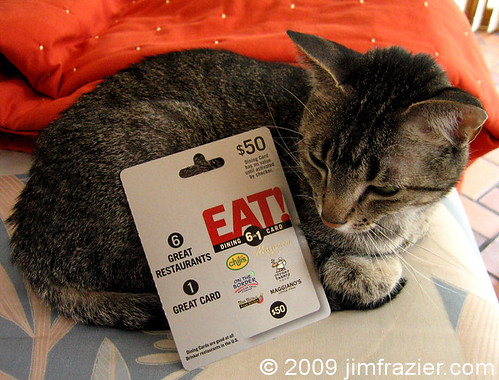
And in most states, gift cards and certificates aren't taxable when you buy them. When I bought that card in the picture above, I paid $50 with no tax. I didn't really pay $50 for a piece of plastic. I'm dumb, but not stupid. I paid that $50 for the right to buy $50 worth of food from one of the restaurants that accept the card. Generally, states will not impose tax on these kinds of pre-purchases. The tax gets imposed on the purchase when the card is used. When they handed me the bill at the restaurant, it included tax. I then simply paid the bill (including the tax) with the gift card.

One exception is phone cards. Most states do impose sales tax on phone cards.

It's too bad money can't buy happiness. Because at least it would be exempt from sales and use tax.


The Sales Tax Guy
http://salestaxguy.blogspot.com

See the disclaimer - this is for education only. Research these issues thoroughly before making decisions. Remember: there are details we haven't discussed, and every state is different.

Get these articles in your inbox - subscribe at http://salestaxguy.blogspot.com

Here's information on our upcoming seminars and webinars.
http://www.salestax-usetax.com/

Picture note: the image above is hosted on Flickr. If you'd like to see more, click on the photo.

Thursday, July 08, 2010

News, Links and Commentary

Arkansas has released rule 2010-1 for tax treatment for vets in that state. If you're an Arkansas veterinarian, all I can say is get the rule, get a bottle of the beverage of your choice and allocate an hour or so to figuring it out. Hey, at least you have some exemptions, so that's something.


Florida would like you to know that there is no sales tax on admissions to these events: National Football League Pro Bowl; National Hockey League All-Star Game; Major League Baseball Home Run Derby held before the Major League Baseball All-Star Game; National Basketball Association All-Star Game; National Basketball Association Rookie Challenge; National Basketball Association Celebrity Game; National Basketball Association 3-Point Shooting Contest; and National Basketball Association Slam Dunk Challenge.

Talk about an exemption that doesn't need to exist.


Georgia passes laws to conform to the Streamlined Sales Tax Project


Illinois now provides that any qualified building materials sold for the Illiana Expressway (to bypass the Borman on the south for you locals) will be tax exempt. This road is years away, but it's nice to know that Blagojevich's replacement is thinking ahead.

And the new guy has signed off on the Illinois sales tax holiday in August. myfoxchicago.com


Michigan's governor gives up on trying to tax services. When are they going to learn? detnews.com


Mississippi's sales tax holiday coming up at the end of July. wapt.com


Be careful about data processing services in New York. While they're not taxable, New York is treating the use of software remotely as the taxable sale of canned software. Sneaky. (New York Advisory Opinion TSB-A-10(4)C, 05/27/2010) There's a little on this from AccountingWeb

A New York restaurant failed to keep anything resembling proper records with missing receipts, paper tapes, mislabeled years. Frankly, it simply sounds like they had a pretty cavalier attitude about accounting. So the state decided to simply observe one day's business (a Saturday) and estimate the restaurant's tax liability from that one particular day.

The message here is keep records! If you don't have anything to audit, the state can start doing things the hard way - for you.


An Ohio company claimed that they were in the business of "transportation for hire" and were entitled to an exemption on the trucks and equipment they purchased. They manufactured materials used BY shippers. That was it. But the owner claimed that they were a common carrier, without being able to show any documentation. "Hey, trust me, I'm a common carrier. Really." The state was not impressed. What's amazing to me is that this got to the appeals board. Either several parties involved in this were really stupid, or there's more to the story. I hope it's the latter.


Oklahoma is the latest state whose legislators seem to have lost it. A new law goes into effect that requires out of state retailers (who have NO nexus) to provide notifications to their customers that they owe OK use tax. The rules are complicated. But I have just one question. If the out of state retailer has no nexus in Oklahoma, and therefore doesn't have to collect tax, how can Oklahoma make them provide all of this notice?

Sales Tax Buzz has some commentary on this.


Tennessee Sales Tax Holiday in August. dnj.com


In Virginia, they're essentially requiring larger vendors to give the state an advance. That'll solve the budget problems they're having and even give them a surplus. But it's just a sneaky way of forcing vendors to lend the state money. Sales Tax Buzz has the details.


The Sales Tax Guy
http://salestaxguy.blogspot.com

See the disclaimer - this is for education only. Research these issues thoroughly before making decisions. Remember: there are details we haven't discussed, and every state is different.

Get these articles in your inbox - subscribe at http://salestaxguy.blogspot.com

Here's information on our upcoming seminars and webinars.
http://www.salestax-usetax.com/