Showing posts with label Resale. Show all posts

Friday, June 18, 2010

Golden Rule: The Resale Exemption

You can have anything you want, as long as you want cheap, plastic crap.This one is so obvious, it's taken me until now to make it a golden rule.

The idea of sales tax is that it's a tax on consumption. In other words, it's a tax on the transaction that involves the final consumer (end user). Most transaction oriented taxes are set up that way.

It's a different story when you start talking about who the tax is imposed on. Some states have a "gross receipts" tax, for example. The tax is legally imposed on the seller, but they are generally allowed to pass it along to the end user. But that "gross receipts" tax is still only imposed on the gross receipts of sales to the end user.

Who is the end user?

It's really hard to positively define them. So we use a negative definition - who isn't the end user? As discussed in the golden rule of taxable sales, "the final consumer is generally going to be the person who bought for any other reason than to resell..."

If you bought something to consume, you're the end user.
If you bought it to save or collect, you're the end user.
If you bought something to give to someone else, you're still the end user.

But if you bought it to resell to someone else, then you're not the end user. You're buying it for resale. The sale to you is exempt in virtually all states. Now before you start telling the good people at Wal-Mart that you're buying for "resale," a word of caution. You still have to go through all the state's registration paperwork, provide the seller with a resale certificate, and you'll have to file sales tax returns. Other than that, simple.

Why do consumption taxes only involve consumer transactions?

Because if the tax was imposed every time there was a sale, then the taxes would pyramid. For example:

The iron mine charges sales tax to the steel mill
The steel mill charges sales tax to the fabricator
The fabricator charges sales tax to parts wholesaler
The parts wholesaler charges sales tax to the component manufacturer
The component manufacturer charges sales tax to the car manufacturer
The car manufacturer charges sales tax to the car dealer
The car dealer charges you sales tax

You wind up paying a whole lot more for that car because everybody added that 8% sales tax into their costs and prices. That's pyramiding. So consumption taxes are only imposed on that last transaction.

The resale exemption justifies other exemptions, to some extent:

Containers
Agriculture
Manufacturing
Direct supplies used by taxable service providers (in some states)

What about use tax?

Remember, that use tax is essentially a loophole plugger and wasn't meant to be a stand alone tax. Even though it technically isn't a tax on the transaction, it still is considered a consumption tax. It is, after all, a tax on use.


The Sales Tax Guy
http://salestaxguy.blogspot.com

See the disclaimer - this is for education only. Research these issues thoroughly before making decisions. Remember: there are details we haven't discussed, and every state is different.

Get these articles in your inbox - subscribe at http://salestaxguy.blogspot.com

Here's information on our upcoming seminars and webinars.
http://www.salestax-usetax.com/

Picture note: the image above is hosted on Flickr. If you'd like to see more, click on the photo.

Monday, September 21, 2009

Two situations where you'll need an exemption certificate - and why!

Exceptions from the default sales tax rules can usually be broken down into four broad categories:

1 Services that are taxed

Exemptions from the tax based on:
2 Organization of the buyer
3 Expected use by the buyer
4 What is being sold

Generally, if something is exempt, because of what it is (item 4) - like food or drugs, then no certificate is necessary. But if it's exempt because of who the buyer is (item 2), or what the buyer's intended use is (item 3), then you'll probably need a certificate from the customer.

In both of these cases (2 and 3), the reason for the exemption is buyer-centric. The buyer is a particular type of organization (eg. government or non-profit). Or the buyer is going to use the purchase in a certain way. Therefore, you will need something from the buyer giving you assurance of their type of organization or their planned use. Because they know, and you don't. But with exemptions that are based on what is being sold (item 4), the exemption is self-evident and usually has nothing to do with the buyer.

The buyer knows who they are and they know what they're going to use the purchase for. So they need to inform you in a way that puts them on "the hook" and gets you "off the hook." That is the purpose of an exemption certificate.

By the way, a short plug: the Four Exceptions are essentially the basis for our Taxing Policies by State webinar. Please join us for states you're interested in.

Sales Tax Guy

See disclaimer

Here's information on our upcoming seminars and webinars And we do coaching!

And please don't forget to visit our advertisers!

Friday, September 11, 2009

Do I have to pay use taxes on my inventory?

Whenever I start talking about use taxes, the question almost always comes up about whether someone needs to pay use taxes on their inventory.

We need to make sure we know what inventory means. Here are some questions:
  1. Did you buy it with the intention of reselling it?
  2. Have you changed your mind about that?
  3. Are you using it as a demo unit?
  4. Have you given it to someone to use but you're still holding it on the books as inventory?
  5. If you're using it as a display item, do you intend to sell it for pretty close to the original price?
If you answered "yes" to the first question and no to the rest, then no matter how long you hold the inventory, you shouldn't owe use tax on it. You bought it for resale and that's one of the most fundamental exemptions for sales and use taxes. Even if you move it from state to state, you still owe no use tax.

Unfortunately, there are other taxes which may apply - such as personal property taxes (in some states).

But with regard to sales and use taxes, you should be off the hook. Just watch your answers to those five questions. Because if you answer wrong, then you've used the inventory and you will owe use tax.

More about withdrawals from inventory here.

Sales Tax Guy

See disclaimer

Here's information on our upcoming seminars and webinars

And please don't forget to visit our advertisers!

Picture note: the picture above is hosted on Flickr. If you'd like to see a larger version, click on the picture, then click on the "all sizes" button above the picture.

Friday, July 10, 2009

You can't just charge tax

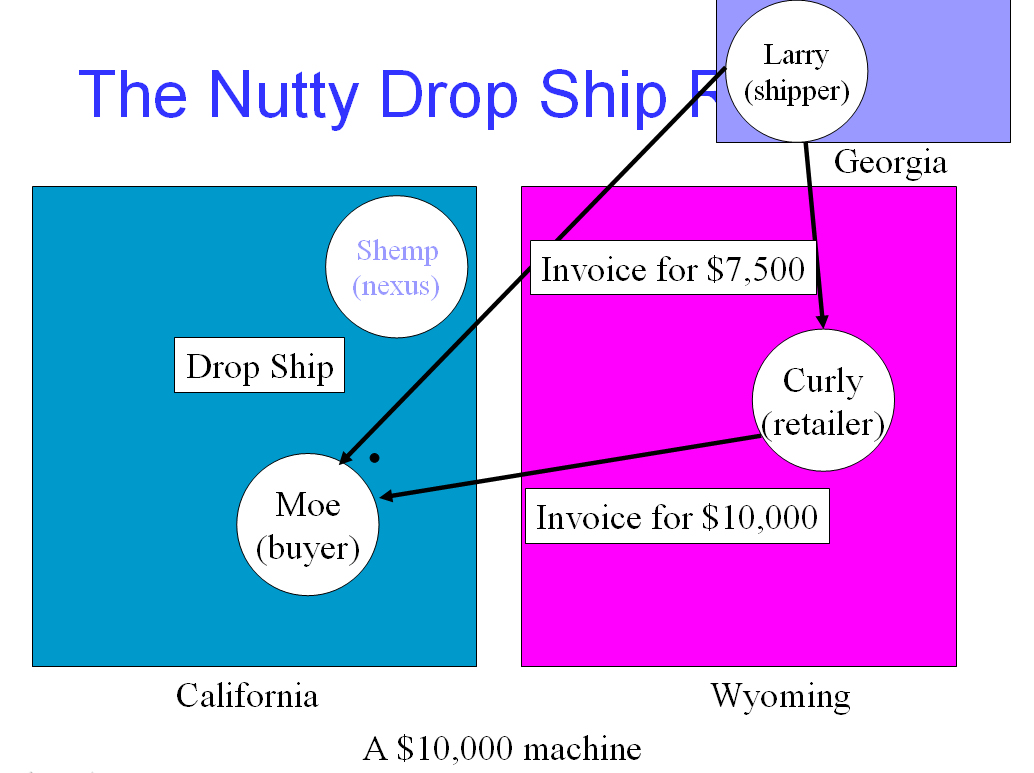
I had an email from a reader the other day asking a follow-up question to the nutty drop ship rule article. [I just reread it and, other than the addition of a chart, it still works...dang I'm good. But I digress.]

Now you're going to have to go back and get the cast of characters straight in that article. The reader is Curly. She goes ahead and pays tax to the vendor (Larry). But she doesn't want her customer (Moe) to have to pay the tax later. So she asked if she can just show the tax on her invoice to Moe so he (and the auditor) can see that it has been paid.

Every state is different in this, so you must research this on your own. But here's the thing. You can't charge your customer sales or use tax unless you actually are registered in the state. This is the law in most states. There are a couple where this isn't the case, and many states have some sort of temporary permitting capability. But the point of this article, even though I'm roping in the drop ship issue, is unless you are registered in the state, in some way, for sales and use taxes, you cannot legally collect that state's tax.

So generally, Curly can't charge his customer tax. I would say that you have to be very careful about this. If you want to simply show the tax as a separate cost, built into the price of the goods, along with inbound freight, labor, expenses, materials costs, etc., that might be OK. The taxes you pay are a cost of doing business.

But if you have a "merchandise total" and then another number for tax, that's going to look fishy and might get you into trouble. It sure looks like you're charging them tax.

The other thing to remember is that the customer might question the charge. He'll be wondering why he has to pay tax. He thought, by buying from you, that he wouldn't have to worry about paying tax. Now you're charging him tax? The fact that the total at the bottom of the invoice is what you quoted probably isn't going to help. And it'll just confuse him more. Can your customer service people field these kinds of questions?

And if that weren't enough, the auditor probably isn't going to care about any "taxes" on the invoice unless you're registered to collect the tax in her state. So putting something called "tax" on the invoice isn't likely to help anyway.

Another option is to do what destination state (where Moe is) wants you to do - register. Then you'll be able to buy tax free because you'll have the proper resale certificate, and you'll be able to legitimately charge your customer tax giving him a proper receipt for taxes paid. But that opens up another can of worms.

I've given you a lot of generalities in this article. You must check to see what the rules are in the destination state.

Sales Tax Guy

See disclaimer

Here's information on our upcoming seminars and webinars


Tuesday, June 16, 2009

Carpet Dealers

Carpet dealers, as well as other flooring and tile sellers and cabinet installers, are often considered construction contractors and treated that way. Under this method, they pay tax on their purchases of carpeting, tile, wood, etc. and make no taxable sales to their customers, just as other contractors.

However, you will see variations. I think the reason is the nature of the transaction. Flooring and cabinets are often bought in a retail setting or out of sample books. The customer really thinks of themselves as buying the actual product, and the services of the installer are incidental.

However, in the standard construction contractor situation, the customer doesn't care too much about the building materials. They are primarily concerned with, and think of themselves as really buying, the finished product.

That's my story, anyway.

For whatever reason though, some states do treat the sale of flooring and cabinetry as the sale of installed tangible personal property. The sale of the product would be taxable to the customer just like any other sale of TPP and possibly even the installation charges.

So there are two main variations (with lots of complications):

1. The seller pays tax on the product when he buys it and doesn't charge his customer any tax at all.

2. The seller buys his product for resale, and then charges his customer tax, just like a normal sale of TPP.

Your cheapest source of information on this will be the state web sites. In my experience, most of them have a publication dealing with this situation because it's the kind of thing that citizens (voters) will ask about. If there isn't anything obvious, look for contractor information, or start digging around in the statutes and regulations.

If you're the buyer, don't assume the seller is doing it right. I've met too many of them that didn't have a clue and were doing it the wrong way.

And guys, if you're looking for a way out, just tell her that the sales tax issues are just way too complicated. You had better put off that purchase until you can figure it out.

Sales Tax Guy

See Disclaimer

Here's information on our upcoming seminars and webinars

And please don't forget to visit our advertisers!

Picture note: You'll understand the last paragraph if you have a look at the photo.

Friday, June 12, 2009

Get those certificates

Novell Stuff

I had a woman in my class once who told me about her experiences in getting resale certificates. She didn't bother.

She worked for a toy manufacturer. And she worked for the distribution division. She sold only to resellers and distributors. There was a sister company who did sell to the end user through their web page and catalogs. But it was a separate company, separate corporation, separate facility, separate everything except products sold and the parent company.

Her company got audited by, we'll say*, Illinois. During the audit, the auditor asked about resale certificates for all of her sales into Illinois. She said, "We don't get them. Our business model is only to sell to retail stores and distributors. None of our customers buy for end use. Talk to our sister company about that. We don't need resale certificates." The auditor said that she did and pointed out the law. But he was nice enough to give her 60 days to get them (not all states are required to provide this grace period).

So she began to work on getting those certificates. And 60 days later, she still owed Illinois $50,000 for the sellers' use taxes she had failed to charge her Illinois customers. Not because her customers refused to provide the certificates. Her company was big enough to demand and get those certificates. She owed money because some of those customers had evaporated. You see, the retail toy business is pretty volatile. Retailers come and go. She owed taxes on the ones that had "gone." If they're gone, she's not going to be able to get a resale certificate.

But if she had simply done what she was supposed to do, she would have owed nothing.

The moral of the story is very simple: get the resale certificate. Get it before you even ship the goods, because that is when you've got leverage over the customer. Don't wait until later or assume the sales rep will get it. You get it now. Here's a procedure you may want to use.

Then you won't have to argue with your customers or run the risk of them going out of business on you.

PS...before you go all notes on some of your customers, you should read these articles about drop ships. And here is much more information on all forms of exemption certificates.

Sales Tax Guy

Here's information on our upcoming seminars and webinars

And please don't forget to visit our advertisers!


*When I use "we'll say", that means I making it up.

Picture note: The toys shown don't represent the company I'm talking about. It's just a picture of toys. You can see it bigger here.

Sunday, May 31, 2009

Accounting and the Container Exemption

I got this tip recently in a seminar. I've never heard of it before, but I thought I'd pass it on because it makes sense

The logic behind containers being exempt is that the box, bag, carton, pallet and other packaging materials were bought for resale. They're essentially sold with the product to the customer - they're ingredients. But a sharp auditor might ask about the accounting for your packaging costs.

In order to be able to argue that the container is part of your product, you may want to account for it that way. In other words, the theory is that you should be including the cost of your packaging materials and containers in cost-of-sales or cost-of-goods-sold, where your other product costs are.

Now, if you're like most companies, those costs are probably being included in your sales and administrative expenses. And you might have some trouble convincing your CPAs of the sound, logical and insightful thinking behind this recommendation.

But it's worth considering to be able to reinforce why your packaging materials aren't taxable.

Note that you should check how the container exemption works in YOUR state. And DO talk this over with your accountants.

Sales Tax Guy
See disclaimer

Here's information on our upcoming seminars and webinars

And please don't forget to visit our advertisers!

Wednesday, May 20, 2009

The Resale Exemption

This is really almost not an exemption. That's because purchasing for resale is fundamental to the concept of sales and use taxes (SUT). SUT is usually a tax on the final consumer (or at least the transaction involving the final consumer). Since someone buying product to resell isn't, by definition, the final consumer, there shouldn't be any sales or use tax. Henceforth, the resale exemption.

If you buy something that you're going to sell to someone else, you shouldn't pay sales or use tax on it. You should provide your vendor with a resale certificate (that's what it's typically called). This gives your vendor reliable assurance that you're not to be taxed and why.

Then, when you sell your product, you must charge your customers tax and remit it to the appropriate state. Unless, of course, your customer is also buying for resale, in which case he/she needs to provide you with a resale certificate.

This is called the resale exemption. This is not absolutely universal, but it's pretty dang close. And it's really not an exemption like food, non-profit organizations, etc. It's fundamental to the entire concept of sales and use taxes.

There are variations on this rule. For example, in most states, real property construction contractors who buy building materials for their projects are considered the end users and are not buying for resale. Lessors, in most states, buy their property for resale because they will be charging the lessee tax on the rental or lease charges. And there are a few states where people, who provide taxable services, can buy some of their materials tax free using this exemption. Finally, the ingredients exemption for manufacturers, as well as the container exemption, are natural extensions of this exemption.

Sales Tax Guy
See disclaimer

Here's information on our upcoming seminars and webinars

And please don't forget to visit our advertisers!

Tuesday, May 19, 2009

Brothers and Sisters, let us now discuss...containers.

When you buy a can of beer, what are you really buying?

When you purchase the can of beer, you're also buying the can, aren't you? Isn't the can sold to you with the product? Therefore, the can is an ingredient in the product called, a can of beer. Therefore, logically, shouldn't the brewery be able to buy the can for resale, just like the ingredients for the beer?

Containers that are sold with the product to the customer are generally not taxable.

If you go to a restaurant and they sell you pop (or soda, whatever) in a cup, they are able to buy that cup for resale. Because it is sold to you with the delicious beverage. But if you get your drink in a glass or a china cup, the container wasn't sold to you with the beverage and the seller should have paid tax when they bought it.

Returnable containers, like a keg of beer or a tank of propane, are generally taxable because they are not sold to the customer with the product. They are bought by the seller, empty of course, and used over and over again. The seller pays tax on those containers because they use them to transport their product to their customers.

But a container that is sold with the product to the customer, is not taxable when purchased by the seller.

By the way, this isn't just a manufacturing exemption. It generally applies to anyone who sells products. The grocery store doesn't pay tax on the bags they put your food into when you make a milk run.

That's the general rule, backed up with logic. But there are significant variations from state to state, mostly with the definition of container and customer.

Just about every state will say that the can itself is exempt. The container that actually touches the product and/or is received by the final consumer of the product, is almost always exempt when bought by the seller of the product.

How about this shipping container?

Box

Usually the box would be exempt, if sold to the customer with the product inside the box. When I got this box, (which I carefully saved unopened so that I could photograph it and use it in this blog) the vendor didn't expect me to return it to them. I got the contents, plus a nice empty box. But, say the seller purchased boxes to ship materials internally from one division to another? In that case, the container would be taxable. It wasn't bought to sell with product to the customer.

But some states, as mentioned above, would not exempt the box, only the container touching the product. If the company shipping this box was in one of those states, they would have had to pay tax since the box doesn't touch the product. What the box contained was software (that I paid tax on...don't worry). In some states, only the software box containing the CD would be exempt, just like the can, because only the software box touched the product.

Let's say that box containing the software was sent to a dealer, who would then put the software on the shelves in their store. In a few states, the box would be taxable because it didn't get shipped to the final consumer.

And then, there's the beloved peanuts.

Peanuts

Some states have a problem with peanuts, bubble wrap, excelsior, etc. because it's not touching the product. The box might be exempt, because it's really containing something. But the peanuts are not a container, therefore they don't qualify for the exemption. In fact, they are being contained.

Shipping labels are often differentiated from marketing labels, or inventory control labels which are usually taxable.

And finally, there's skids (or pallets - whatever).

e050530f002a

Pallets are barely containers. You could say that they are the bottom part of a container made up of the stretch-wrap on 5 sides and the pallet on the bottom. Might be tough, though.

Often, the state's rules don't use the term container, they use a variation on wrapping supplies or shipping materials. That's a good thing because then you can pretty much fold everything I've talked about into that definition, as long as the wrapping materials are sold with the product to the customer. But that also leaves room for the auditor to wiggle as well. I can see an auditor trying to make the case that the peanuts really aren't wrapping the product. I'm just sayin'

When I'm researching a state, I'll look for mention of specific items, like dunnage (a really obscure term for peanuts) and pallets. If a state exempts those things, I figure we're home free.

Hopefully it's obvious that people who sell services usually don't sell product. Therefore, there's no container exemption for them. Your CPA doesn't get to buy the envelopes, in which he sends out reports, tax free. He really hasn't sold a product. The report is really just the work product of his services. Except that, in a few states, dry cleaners bags are exempt when bought by the dry cleaner. Go figure.

Summary:

1. If you sell stuff, and you buy containers, you should see if you qualify for the container exemption. A lot of new businesses don't realize that this stuff is exempt to some degree.

2. You need to get as much information on the laws in the state where you receive and use those containers. What do they consider a container? And does the container have to get sold to the final consumer?

I've got a few more issues to talk about, but you've gotten enough to chew on for now. Stay tuned.

Sales Tax Guy
Please see the disclaimer

Here's information on our upcoming seminars and webinars

And please don't forget to visit our advertisers!

Thursday, September 20, 2007

A Certificate Isn't Enough!

Here's a question I recently got (I've edited it a little):

"I am selling someone a machine, and they have provided me with their tax id number. Is this enough? What else do I need and how do I report it on my return?"

Every state is different so make sure you check the local statutes and regulations. But here are the general rules:

1. You'll need a certificate from the buyer, usually signed, describing the situation, and showing their registration number with the state. Each state has their own set of forms and requirements. Check the forms section of the state Web site. Just the number itself usually will not do it. And make sure the number is the state's assigned number, not the federal employer ID number.

2. The transaction must truly be exempt from tax. If you know it's taxable, even if they give you the proper paperwork, you usually must still charge tax. For example, if your friend is a funeral director, and he's buying a cash register, it's probably not for resale. Even with a resale certificate, you'll probably need to charge tax. Again, state rules vary - I'm giving you the most conservative perspective.

3. As far as reporting it on the return, read the instructions. Most states require you to report your gross sales and deduct your exempt sales.

Sales Tax Guy


Wednesday, September 12, 2007

Get Exemption Certificates! Always!


Part of a series on essential actions you need to take

This should be the standard policy in your company:

We will always charge tax unless we have the resale or other exemption certificate, or other necessary paperwork IN HAND prior to shipment.

The benefits of doing this are:

1. You assure that the sale really is exempt from tax. You're not making any assumptions (and we all know what happens when you assume, don't we?).

2. You won't have to deal with trying to collect the money later when you get audited and find out that the sale was taxable.

3. You don't have to rely on the customer to send you one when you get audited. And depending on the state, you may have a limited amount of time to get those certificates.

4. You avoid problems with customers that vanish (go out of business), and therefore won't be able to send you a certificate two or three years later when you get audited.

If you stick to this policy, you'll have to do more "credit memos", but people who do this tell me it works well and they are happy with the results. You owe it to yourself to give this a shot.

The Sales Tax Guy

Thursday, November 16, 2006

Do I have to charge tax if I've already paid tax?

Here's the question:

I have a question for the sales tax guy! I have not yet been able to find the answer. My business is registered as a self proprietership. I make jewelry. I buy my supplies from various locations, some of which charge me tax. If I pay tax on the supplies, do I still have to charge sales tax to my customer? What if I make a piece of jewelry where some I paid sales tax on some supplies, but not others?

Here's the answer:

I refer to this as the "Second Golden Rule of Sales and Use Tax."

ANYTIME there is a retail sale, tax must be charged (except for many, many exceptions). By selling your jewelry, you are making a retail sale and should be charging tax to your customers.

What you should do is buy your ingredients, the stuff that goes into your product, for RESALE. Then you don't pay tax on your purchases. You only charge tax to your customers (and remit to the state, of course).

The fact that you already paid tax doesn't get you off the hook. The object is to tax what YOU sell to the final consumer. The tax will be higher because it has your profit in it. Which is what the state wants.

So register with the state, get your resale number, use it to buy your ingredients for resale and charge your customers tax.

By the way, the other stuff you buy that doesn't go into your product, IS taxable. In that case, YOU'RE the end user. However, there might be manufacturing exceptions here, depending on the state your're in.

Thanks for the excellent question. I'd strongly suggest you talk to your CPA about this as well.

Sales Tax Guy
See disclaimer

Friday, September 29, 2006

Why is my vendor charging me tax on drop shipments?

Drop Ships

Here’s the problem.

- Moe (in California) orders goods from Curly, the retailer.
- Curly (in Wyoming) orders goods from Larry, the manufacturer or distributor.
- Larry (in Georgia, but with nexus in California) ships the goods to Moe.
- Larry bills Curly.
- Curly marks it up and bills Moe.
- Curly is registered ONLY in Wyoming, has a WY resale certificate and does NOT have nexus in California. Which means he doesn’t charge Moe any tax.

In, what I like to call, the “nutty” drop ship states (California is one of them), they require that Larry must charge CA tax to Curly, even though Curly is buying for resale. They will let Larry off the hook for the tax if Curly provides Larry with a California resale certificate (and CA registration number, of course). Curly doesn’t have this because he doesn’t have nexus in CA. And he doesn’t want to register in CA and therefore collect tax because he’ll loose any competitive advantage he has in CA, aside from the other problems with letting CA know he’s out there.

So Larry must collect the tax from Curly and Curly obviously has his margins squeezed. And he can’t pass on the tax to Moe because he’s not registered to collect tax in CA.

Moe also loses here because, since he has an invoice from Curly with no tax shown, the auditor will assess him for use tax on the purchase that Larry has already paid the tax on!

Many vendors (Larry) have been caught on this issue by NDSS (nutty drop ship states), so many of them just automatically follow these rules, regardless of whether they’re shipping to a NDSS or not. This causes problems for the Curlys of the world because they’re being forced to pay tax that isn’t truly due.

If you find yourself in this situation, I recommend that you research the NDSS situation in the ship-to state, and then challenge the vendor. Make them show you where they’re required to charge tax and show them what you’ve come up with. And of course, depending on the relationship you have with the vendor, don’t pay the tax.

There's more on this here

Sales Tax Guy
Of course, the usual disclaimers

Picture note: the illustration above is hosted on Flickr. If you'd like to see a larger version, click here


.tdropships

Saturday, May 27, 2006

Certificates

Here are some thoughts about accepting certificates (exemption and resale) from your customers:

1. GET THEM! Get them before you ship to avoid hassles down the road, and to assure that the sale IS exempt, and the sales rep isn't trying to slip something past you.
2. Make sure they are completely filled out, per the form's instructions.
3. Check the rules for the state where the delivery is made. If it's a "drop ship rule" state, you'll need the resale certificate (and registration number) from that state.
4. As a general rule, getting the certificate from the state where the final delivery is made is a good idea.
5. Make sure the registration number is from the correct state. Watch out for FEIN numbers, which are often used incorrectly.
6. Accept the certificates in "good faith." If there's something about the transaction that you know is not exempt, either because the certificate itself is obviously a problem, or you just know that what you're selling isn't exempt, then you should charge tax. You're not accepting it in good faith.
7. In certain situations, states put an added burden beyond good faith. To be safe, ask your customer to also provide you with a copy of whatever paperwork they got from the state (eg. the resellers permit). For even more protection, confirm the number is valid with the state. Some allow an automated process, confirmation by email, or may provide a look-up function on their web site.
8. Check expiration dates for the various states. You're probably in good shape if you refresh your certificates every three years. Simply go through your customer list and ask for a new certificate from one third of them every year. That way, you'll never have a certificate that's more than three years old.
9. Speaking of dates, make sure that the dates match your sale. It won't do you any good to get an exemption certificate that's effective in 2006 if your sales to the customer were in 2005.
10. There is software available to help you manage this process. I won't make any recommendations, but a web search may help you.
11. Follow the instructions, both on the form and on the state's web site when accepting certificates.

Sales Tax Guy
See disclaimer